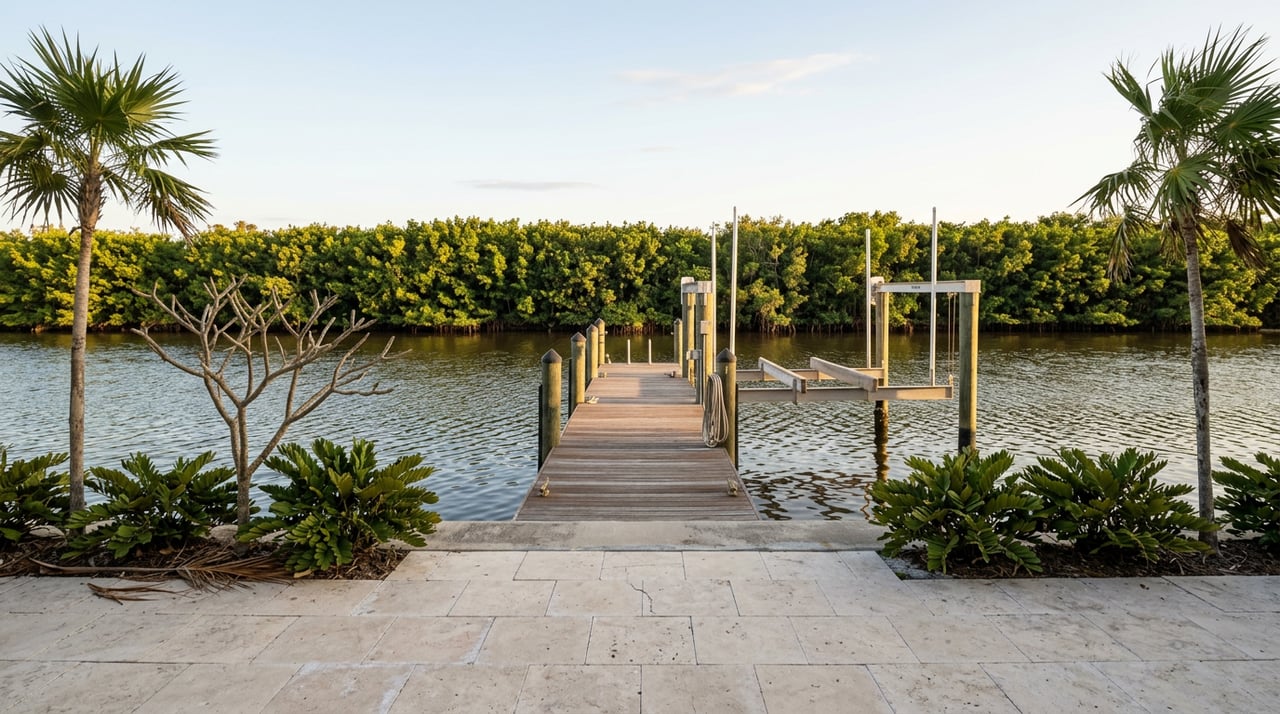
Two homes sit on the same canal system in Jupiter. Same builder era, same 100 feet of seawall, same asking price per square foot. One will sell for materially more than the other, and the difference has nothing to do with the kitchen or the pool. It comes down to a phrase buried in the listing remarks: no fixed bridges.
On paper, both properties can claim it. In practice, only one of them delivers it, because the phrase describes the closest bridge to the dock, not every bridge between the dock and the Jupiter Inlet. A buyer who stops checking after the first crossing can end up with a boat that is blocked the moment it reaches a second, lower span two turns down the canal.
That gap between what a listing implies and what a buyer's actual boat can do is the single most consequential detail in Jupiter's waterfront market right now, and it rarely shows up as a line item anywhere in the transaction paperwork.
Fixed Versus Draw: A Distinction Worth Learning Before You Tour
A fixed bridge has a set vertical clearance that does not change with the tide or a call to a bridge tender. If a boat's air draft, the height from the waterline to its tallest point with the tower or hardtop up, exceeds that clearance, the route is closed to that vessel. Not just at low tide. Permanently.
A drawbridge opens for boat traffic, either on a published schedule or on demand. It adds a wait, not a wall. That distinction changes what a home can actually deliver for a buyer who plans to use the water rather than just look at it.
Jupiter's canal system has both kinds within a few miles of each other, and the town's own current bridge work makes the point directly. The U.S. 1 bridge over the Loxahatchee River and Intracoastal Waterway closed for an extended stretch during a Florida Department of Transportation replacement project and reopened in late 2024 as a twin double-leaf drawbridge with up to 42 feet of vertical clearance and a 125-foot-wide navigable channel, a real upgrade for taller boats that previously had to plan around a lower, older span. Indiantown Road and Donald Ross Road each open on the hour and half hour at 35 feet of clearance. PGA Boulevard opens on the same schedule at 25 feet.
Compare that to the fixed spans a few turns away. The A1A bridge over the Loxahatchee River sits at roughly 25 feet at mean high water and does not open at all, which is why a long stretch of homes upriver of it are effectively sealed off from anything taller than a center console or a low-profile cruiser. The Center Street bridge over Sims Creek clears about 4.5 feet. The Island Way bridge, which serves the canal system around the Islands of Jupiter, clears roughly 12 feet. None of those numbers move on a schedule. They are the ceiling, full stop.
| Crossing | Type | Clearance at mean high water |
|---|---|---|
| US-1 (Federal Highway) over the Loxahatchee River/ICW | Drawbridge, opens on demand | Up to 42 ft (rebuilt) |
| Indiantown Road | Drawbridge, hour and half hour | 35 ft |
| Donald Ross Road | Drawbridge, hour and half hour | 35 ft |
| PGA Boulevard | Drawbridge, hour and half hour | 25 ft |
| A1A over the Loxahatchee River | Fixed | ~25 ft |
| Island Way (Islands of Jupiter) | Fixed | ~12 ft |
| Center Street over Sims Creek | Fixed | ~4.5 ft |
Why the Marketing Language Clusters Around Certain Communities
This is why "no fixed bridges" shows up so often in listings for Admirals Cove, Jonathan's Landing, The Bluffs, the Islands of Jupiter, and Jupiter Inlet Colony. These communities sit on canal geometry that gives a boat a straight run to the Intracoastal and the inlet without crossing one of the low, fixed spans upriver. It is a real feature of the land these neighborhoods occupy, not a phrase a listing agent adds for flavor.
It is also why a smaller waterfront pocket like Sims Cay markets itself differently. Homes there sit behind a single fixed bridge on the way to open water, which works fine for a kayak or a small day boat and is a hard stop for a sportfisher with a tower or a sailboat with standing rigging. The listing can still say waterfront. It just cannot say no fixed bridges and mean it for every vessel.
The mistake buyers make is treating the phrase as binary, present or absent, rather than tracing the specific route their own boat would take. A route can clear three bridges cleanly and still fail on the fourth. The listing rarely mentions the fourth.
What the Median Price Doesn't Show You
Jupiter's headline numbers this year describe a market that has cooled from its 2021 to 2022 pace without falling apart. Median list price sat at $879,000 in February 2026. City-wide, MLS data refreshed as recently as August 10, 2026 puts the median sale price at $600,000, flat year over year, with homes taking about 50 days to go under contract and buyers negotiating roughly 7 percent off asking. Inventory sits at about 3.4 months of supply, which is balanced territory rather than a seller's runaway.
Pull three separate trackers for the same stretch of 2026 and you get three different stories. One shows the average home value down slightly year over year as of mid-2026. Another shows a three-month median down 5 percent through May 2026, while a summer 2026 reading from the same tracker showed the average price up more than 9 percent year over year. A third put the median home price up more than 25 percent year over year in January 2026. None of these figures are wrong. They are measuring different slices of a market where the high end moves on a different logic than the entry-level segment, and waterfront is where that split shows up hardest.
A single median can absorb a swing of a million dollars or more between two houses on the same street without blinking, because the variable that actually explains the swing, whether a boat can clear every bridge between the dock and open water, never appears in the dataset. That is not a flaw in the statistics. It is a reminder that the median tells you what a typical Jupiter home sold for, not what a specific waterfront lot is worth to a specific buyer with a specific boat.
Three Things Worth Checking Before You Write an Offer
A softer, more balanced market gives buyers something they did not have in 2021: time and leverage to check the details rather than compete on speed alone. Three checks are worth the extra hour before an offer goes in.
Trace the entire route, not just the nearest crossing. A canal can wind past two or three bridges before it reaches the Intracoastal, and the listing photo only shows the one closest to the dock.
Measure clearance at high tide, not low. Fixed bridge clearances are published for mean high water. A boat that clears comfortably at low tide can catch the bottom of the same bridge six hours later.
Match the clearance to the boat's actual air draft with the tower, outriggers, or antenna array up, not the base spec from the manufacturer's brochure. The gap between those two numbers is exactly where buyers get surprised after closing instead of before it.
None of this shows up in a home inspection. It is local knowledge, the kind that comes from knowing which canals actually connect to open water and which ones stop at a fixed span, and it is worth confirming before a boat that does not fit the route becomes a problem the new owner discovers on the first weekend.
Frequently Asked Questions
Does a boat lift solve a low fixed bridge? No. A lift changes how a boat sits at the dock. It has no effect on the vertical clearance of a bridge between that dock and open water.
Is "no fixed bridges" the same claim everywhere in Jupiter? No. The phrase describes one route from one dock. Two docks on the same canal can have different answers depending on which direction they run and how many crossings sit between them and the inlet.
Does this affect resale value, or is it only a lifestyle preference? It affects resale value directly for any buyer who plans to keep a boat with real height, since the next owner will be checking the same route for the same reason.
If you are comparing Jupiter waterfront listings and want the actual route checked before you fall for a view, Isaias Franco can walk the bridge clearances with you, canal by canal, before you write an offer. Request a free home valuation to start the conversation on your specific property or search.