Pull up three real estate data sites for Golden Beach on the same afternoon and you will get three different numbers for the median home price. One will land in the high single-digit millions. Another will sit near $13 million. A third will clear $20 million. Check the fine print and you will find they are not even measuring the same thing: one is tracking sold prices, another is tracking list prices, and the trailing windows do not line up. None of these numbers is wrong. All of them are current as of 2026. And none of them tells you what a house in Golden Beach actually costs, because Golden Beach does not really sell houses the way that generates a stable median. It sells land, in a market so thin that a single closing can swing the average by millions.
That is the number worth understanding before you write an offer or set a list price here: not the median, but the price of the ground beneath the house, sorted by which body of water touches it.
A market too small for its own median
Golden Beach is a barrier-strip town incorporated in 1929, home to somewhere between 350 and 400 single-family residences squeezed onto a mile of land between the Atlantic Ocean and the Intracoastal Waterway. The Town Charter has kept it that way on purpose: no commercial parcels, no hotels, no high-rise condominiums, nothing but single-family lots since the town's founding.
That scarcity is the whole story, and it is also why the headline price you see on any given portal is close to meaningless in isolation. Consider what a buyer researching the town in the summer of 2026 would actually find. One widely used home-value estimator reported a median sale price of $8.8 million over the three months ending May 2026, with homes taking 175 days to sell. A different aggregator, pulling August 2026 listing data, put the median list price at $12.4 million and reported homes sitting for a median of 961 days. A third source, using March 2026 figures, reported a median sale price above $20.5 million at roughly $3,265 per square foot, while its trailing twelve-month sold median came in closer to $10.8 million at $2,057 per square foot. A fourth, tracking April 2026 activity, put the median at $15.75 million with an average of 212 days on market.
| Window reported | Metric | Reported figure | Days on market |
|---|---|---|---|
| 3 months ending May 2026 | Median sold price | $8.8M | 175 |
| April 2026 | Median list price | $15.75M | 212 |
| July 2026 | Median list price | $20.95M | Not reported |
| August 2026 | Median list price | $12.4M | 961 |
| March 2026, trailing 12 months | Median sold price | $10.8M | Not reported |
These are not contradictory data errors. They are what happens when a handful of transactions a year get divided into a single statistic. Golden Beach does not generate enough closings for a median to hold still the way it does in a market with hundreds of annual sales. One $30-million estate closing in a given quarter, or one modest interior lot trading at $4 million, is enough to move the town's median by a margin that would be unthinkable in a larger market. Comparing the number from one site to the number from another is not comparing apples to apples. It is comparing two different small samples of the same short list.
What the land is actually priced on
If the town-wide median cannot be trusted, the more useful unit is the price per square foot of land, sorted by frontage type. A review of the last 24 months of closed sales against Miami-Dade County lot records shows three distinct tiers.
| Frontage type | Median $/sq ft of land | Range |
|---|---|---|
| Oceanfront | $778 | $254 to $1,625 |
| Intracoastal / dock | $840 | $645 to $1,932 |
| Dry / interior | $407 | $254 to $634 |
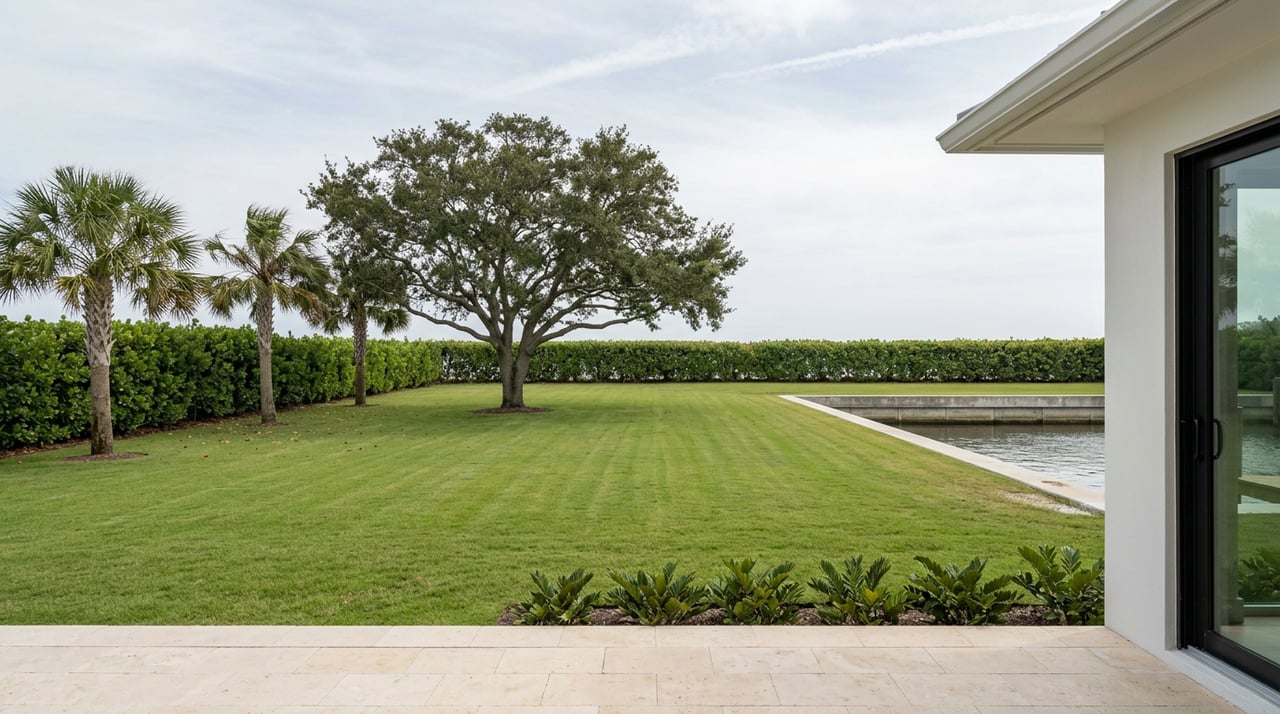
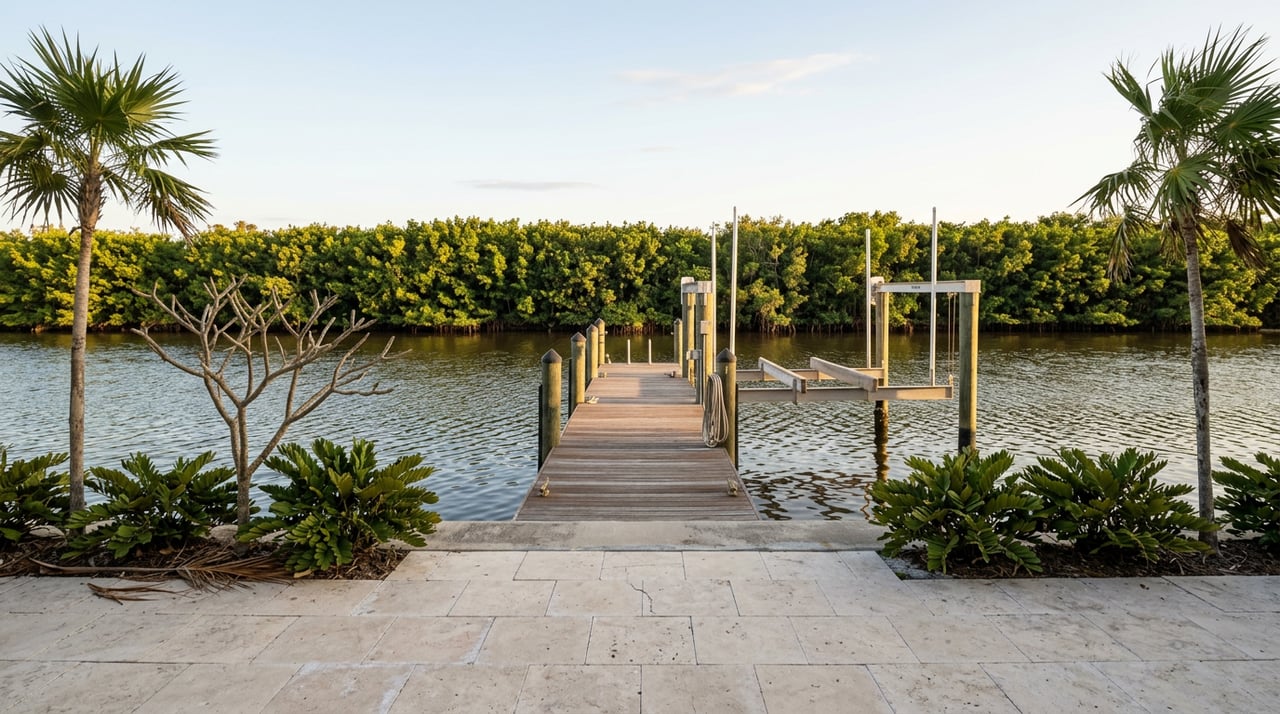
The counterintuitive part is that intracoastal land, not oceanfront, carries the higher per-square-foot median. Oceanfront estates in Golden Beach tend to sit on very large lots, which dilutes the per-foot figure even as the total sale price runs higher. Intracoastal parcels are smaller and carry concentrated dock value, since deep water access for a serious yacht is itself scarce inventory. The result is a premium that inverts once you divide by land area instead of looking at the sticker price alone.
The width of each range matters as much as the median. On oceanfront land specifically, one recent sale of newer construction closed near $1,625 per square foot of land, while an older 1980s structure on comparably positioned oceanfront dirt sold closer to $254, a more than sixfold spread on the same class of ground. That spread is not really about the land. It is about what the structure sitting on it is doing to the number. The low end of each range is close to what a buyer pays when they are underwriting a teardown and valuing the dirt on its own. The high end is what the market has shown it will pay when the structure itself is new enough, or good enough, to be worth living in without touching. A seller holding an older, dated structure should expect offers to cluster near the floor of their frontage tier's range regardless of staging or interior updates, because a serious buyer here is pricing the ground first and the house second, if at all.
Why more money can't buy more house
The reason land carries this much of the pricing conversation is that Golden Beach's own building code puts a hard ceiling on how much structure any given lot can support, no matter the buyer's budget. Town ordinances cap main residence height and require the building to step back from the property line as it gets taller, a rule that adds roughly one additional foot of setback for every foot of height above the first 18 feet. A Coastal Construction Control Line further limits how close to the dune a structure can sit on oceanfront parcels. A 2021 zoning variance filed with the town illustrates the mechanics in practice: a homeowner requesting permission to raise the first habitable floor from 20.02 feet to 23 feet above sea level, while still capping total building height at 50.5 feet. Even a variance request does not remove the ceiling; it just moves it slightly.
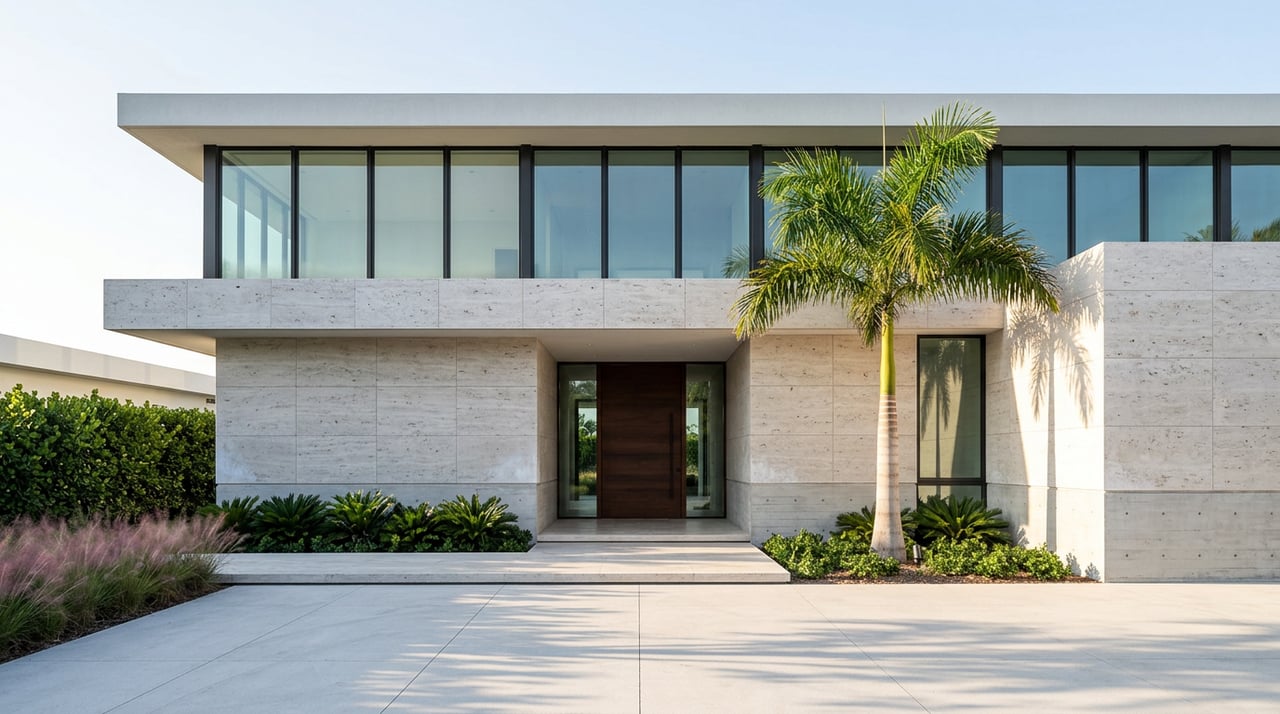
That ceiling is why so much of the current construction activity in town treats the existing structure as disposable. Buyers routinely pay for a lot with the intention of demolishing what is on it and rebuilding to the code-allowed envelope, and the architecture firms doing that work in Golden Beach right now, among them Kobi Karp, Choeff Levy Fischman, and SDH Studio, are building new homes that max out the height and setback rules rather than trying to expand beyond them. A recently completed home on Ocean Boulevard, built by TREO and SDH Studio, is a case in point: a full teardown-and-rebuild rather than a renovation, finished with natural stone and no stucco. When the building envelope is fixed by code, the only lever left for adding value is what you build inside that envelope, which is exactly why land, not square footage of finished house, is the more stable thing to price against.
The insurance line that changes the math
Every Golden Beach lot sits on a barrier strip between two bodies of water, which puts most of the town inside FEMA's higher-risk flood zones. Since October 1, 2024, Florida law has required sellers in most residential transactions to disclose flood risk before contract execution, including whether the property sits in a Special Flood Hazard Area. The statewide average cost of a National Flood Insurance Program policy runs close to $938 a year, but that average hides enormous variation. In the highest-risk coastal zones, premiums can run into the thousands annually, and federal coverage caps out at a fraction of what it would cost to rebuild a multimillion-dollar home, which is why private supplemental coverage is typically part of the real carrying cost on anything oceanfront or intracoastal here.
An elevation certificate is not paperwork to gather after an offer is accepted. It belongs in the underwriting from the start, because an unresolved insurance picture on an older structure pushes the eventual sale price toward the land floor even faster than age alone would.
What this means if you are comparing addresses
If you are weighing two Golden Beach properties, or trying to size up whether a listing is priced to the market, three things matter more than the headline number on any portal. First, ask which of the three frontage tiers the lot actually falls into, since that alone predicts the per-square-foot band more reliably than a renovated kitchen or a recent paint job. Second, ask for the property's specific building envelope under current height and setback rules rather than assuming the lot size alone tells you what can be built. Third, pull the elevation certificate and a real insurance quote before you write an offer, not after, since that number can move the effective price of the home by a meaningful amount over a holding period.
Is the beach in Golden Beach open to the public? No. It is a private, resident-only beach accessed through the town's own beach pavilion, one of a small number of genuinely private residential beaches on Florida's Atlantic coast.
Can you build a condo or run a short-term rental in Golden Beach? No. The Town Charter restricts the town to single-family residential use and prohibits commercial development, which is the same rule that keeps the housing stock capped at a few hundred lots.
How many homes actually sell in Golden Beach in a typical year? Based on the same closed-sale data referenced above, well under 20 in most years, which is exactly why one large or small closing can swing the town-wide median enough to make portal-to-portal comparisons unreliable.
Golden Beach rewards buyers and sellers who price the land first and let the house follow, and getting that sequence right takes more than a portal estimate. If you are trying to make sense of a specific lot, whether oceanfront, intracoastal, or interior, Isaias Franco can walk through the address-specific numbers with you. Request a free home valuation to start with a number built for your property, not a town-wide average that a single sale could move.